Six agents gather the evidence. Your curators make the call.
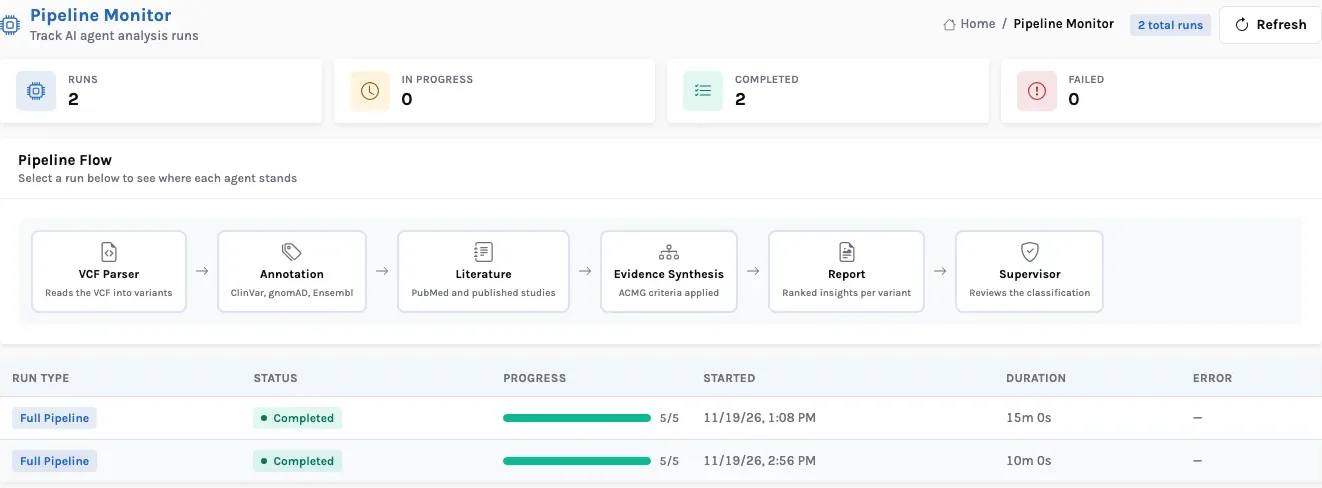
Each InsightVariant agent owns one discrete job in variant interpretation, with a bounded prompt and its own tools. LangGraph orchestrates them as an explicit state graph with retries and human approval gates, and every step is logged with its status, duration, tokens and model.
Read · VCF Parser
VCF Parser Agent
Parses VCF files, normalises variants to GRCh38 and extracts HGVS notation for coding (c.) and protein (p.) changes. Identifies gene symbols and transcripts, the consequence (missense, nonsense, frameshift, splice, synonymous) and the impact level (HIGH, MODERATE, LOW, MODIFIER), with quality, filter status and zygosity.
Toolsparse a VCF record, predict consequence
What it hands on
Structured variant records with every field populated, and a flag on any variant that could not be normalised or annotated, so nothing drops out silently.
People decidethe sample, reference genome and phenotype terms the run starts from
Gather · Annotation and Literature
Annotation Agent
Queries ClinVar for clinical significance and review status, gnomAD for global and population allele frequencies, OMIM for gene-disease entries, UniProt for protein domains, and Ensembl VEP for SIFT, PolyPhen-2 and CADD predictions. Each annotation keeps its source, identifier and fetch time, and conflicting annotations across databases are flagged.
Toolsquery ClinVar, gnomAD and OMIM, predict consequence
Literature Agent
Searches PubMed for publications on the variant (by HGVS, rsID or gene and position), the gene and its diseases. For each study it extracts the type (case-control, cohort, case report, meta-analysis, GWAS, functional), cohort size, effect size, p-value, population and the relevant excerpt, and scores its relevance. Every record carries its PMID and DOI.
Toolssearch PubMed
Grade · Evidence Synthesis and Report
Evidence Synthesis Agent
Applies the ACMG/AMP criteria systematically: very strong (PVS1), strong (PS1–PS4), moderate (PM1–PM6), supporting (PP1–PP5) and benign (BA1, BS1–BS4, BP1–BP7). It weighs clinical databases, population frequency, in-silico predictors, functional studies and the literature, suggests a classification with a confidence score, explains conflicting evidence and names the gaps that could change the call.
Toolsquery ClinVar and gnomAD, search PubMed
Report Agent
Writes the insight cards for each variant (classification, functional, population, clinical and literature insights), each with a title, summary, detail, the criteria applied and consistent citations, ranked by relevance and evidence strength. Reports cover cancer risk estimates, management recommendations, pharmacogenomic implications and cascade-testing guidance.
People decidewhich insights stand, and what goes into the signed report
Oversee · Genomic Analysis Supervisor
Genomic Analysis Supervisor
Orchestrates the pipeline: parse, annotate, search the literature, synthesise and report, in order, with annotation and literature in parallel where possible. It takes high-impact variants first, retries a failed step, validates output quality and manages the token budget.
Recordsevery run and every step: status, duration, tokens used, model
Curator override at any step
The graph is explicit, not a chain of prompts: deterministic state transitions, failure recovery per node, and human approval gates. A run is replayable on the same inputs.
People decidethe final classification; an agent’s output is never the last word
Two playbooks the agents run
A playbook sets the sections of a run, the agent that owns each one and the questions it must answer, weighted by priority.
Genomic variant analysis
Comprehensive interpretation under the ACMG/AMP guidelines, from VCF to ranked insight reports.
- VCF parsing & normalisation · VCF Parser
- Database annotation · Annotation: ClinVar, gnomAD, OMIM, UniProt, Ensembl
- Literature search · Literature: PubMed, functional studies, case reports, GWAS
- Evidence synthesis & classification · Evidence Synthesis
- Insight report generation · Report
Pharmacogenomics
Drug-gene interactions, metabolizer status and dosing recommendations.
- PGx variant identification · VCF Parser: PharmGKB genes (CYP2D6, CYP2C19, CYP2C9…), star-allele diplotypes
- Drug-gene interaction annotation · Annotation: PharmGKB, CPIC, DPWG, FDA drug labels
- Metabolizer status & recommendations · Evidence Synthesis: phenotype per gene, CPIC-based dosing, high-risk pairs flagged
Where people stay in charge
- Agents suggest, people classify. The suggested tier, its criteria and its confidence are inputs for a qualified reviewer, who accepts, edits or overrides them.
- Nothing uncited. Every statement in an insight is backed by an evidence record with its source; gaps and conflicts are named, not smoothed over.
- Auditable by design. Per-step tokens, model versions and timings make each run reviewable and its cost visible.