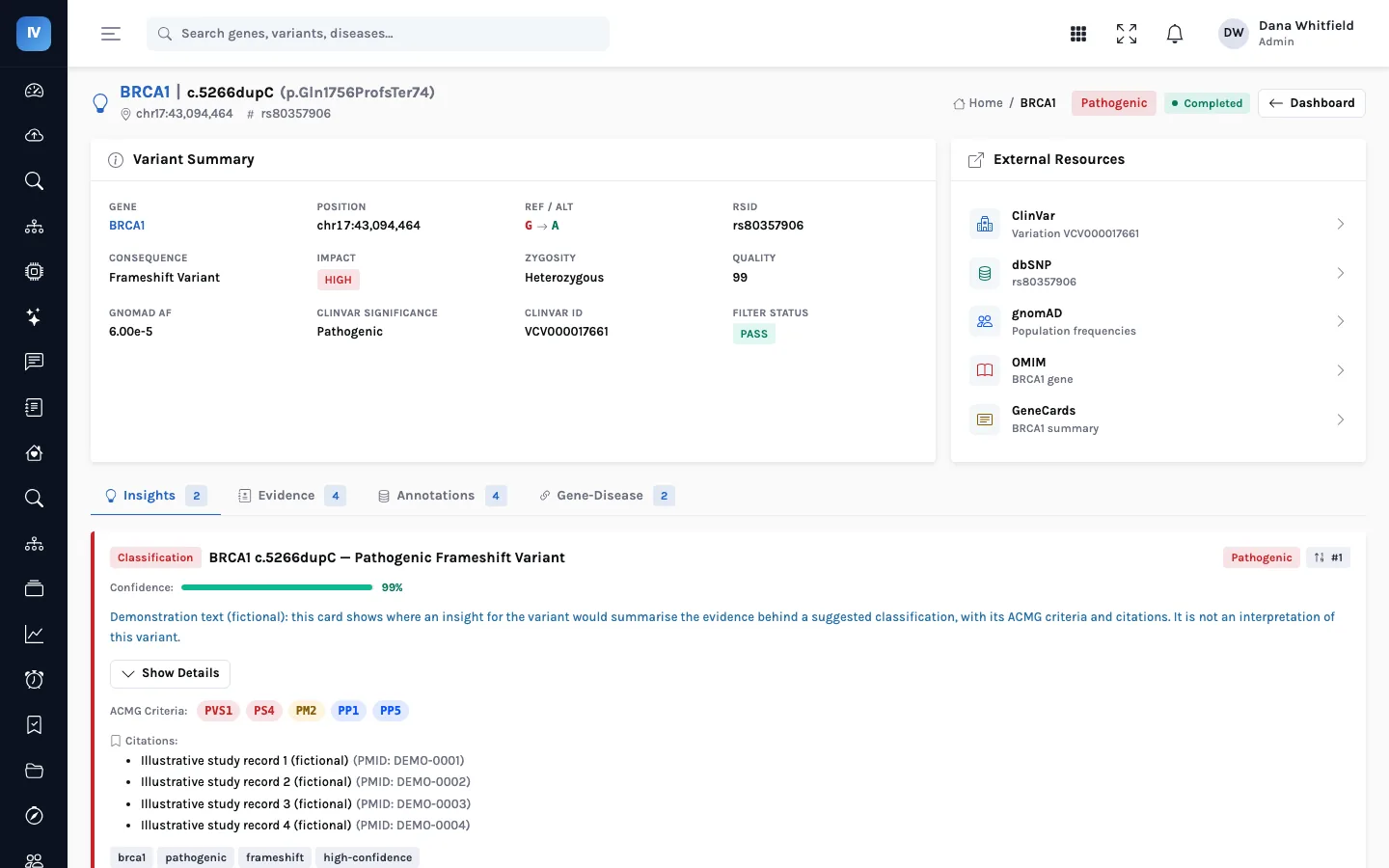
Most variants in a research gene panel are not the famous ones. Many are of uncertain significance (VUS): there isn't enough evidence to call them either way. The risk for a research group is not misclassifying them, but forgetting them. This example follows a made-up cardiovascular research group keeping its uncertain variants visible.
Research use only
A VUS is a research question. Nothing in this example is a clinical interpretation; the sample is a fictional demo sample.
In short
- Register the sample with its phenotype terms: HPO-coded features help prioritise which variants and literature matter.
- Uncertain and pending variants stay visible on the dashboard counts and in the upload's variant table.
- New evidence becomes a record with its criteria, strength and direction, attached to the variant.
- Reviewing is a group decision, and staying VUS is a valid outcome.
The situation
The Halvorsen cardiovascular genetics study
The fictional Halvorsen group studies inherited cardiomyopathies. A demo sample's cardiovascular gene panel has three variants of uncertain significance in MYH7, MYBPC3 and FBN1, all pending analysis. The group wants them kept in view and revisited when the literature moves.
1. Register the sample with its phenotype
Upload VCF takes the file name, a sample ID and the reference genome (GRCh37 or GRCh38), then phenotype terms. Common terms can be picked from suggestions, or any HPO term added. The page says what happens next: the upload appears on the dashboard, analysis can be started on it, and progress is followed in the Pipeline Monitor.
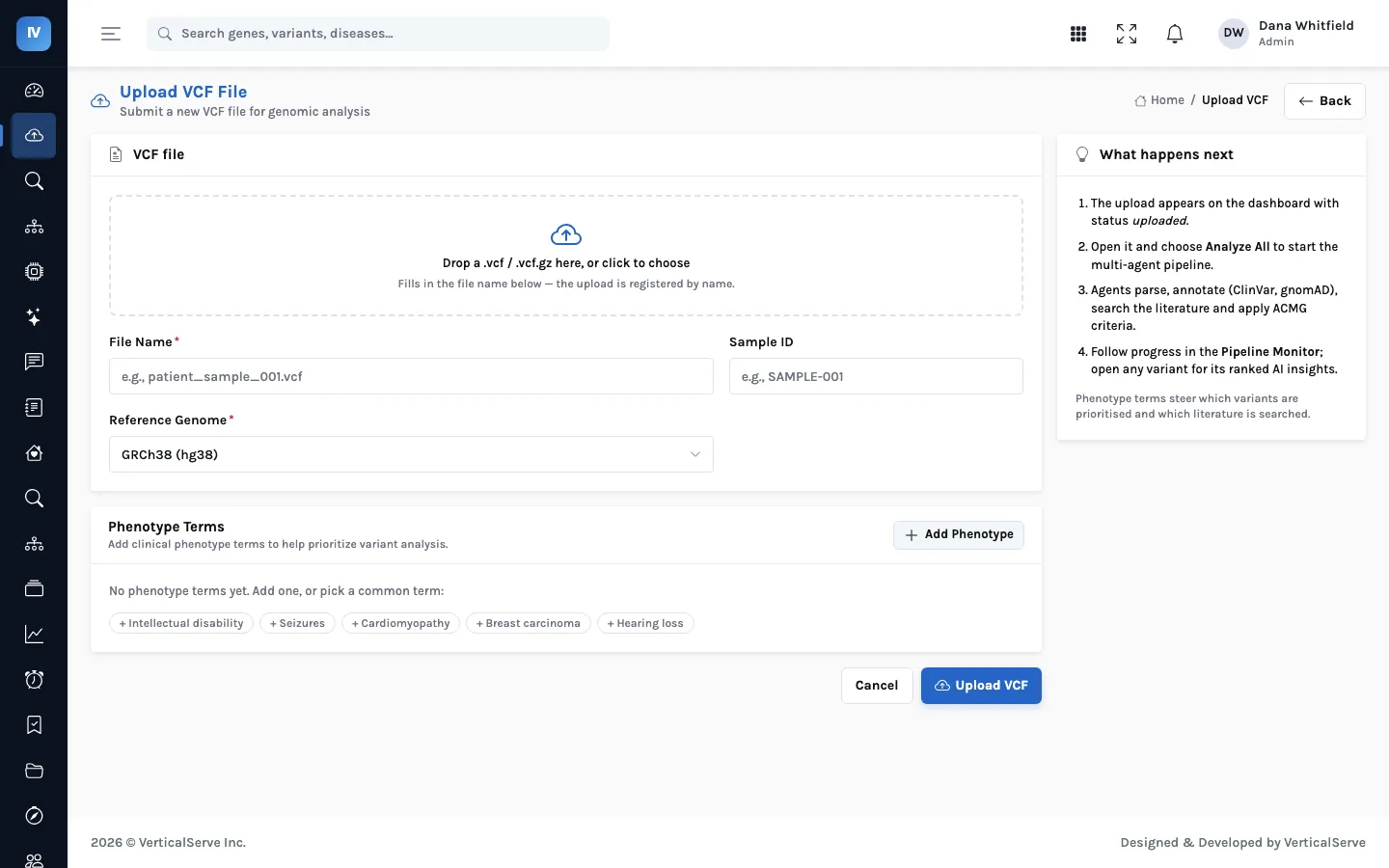
Phenotypes can be added later too. On the upload's page each term takes an HPO term and ID, free text, a category, the age of onset, a severity, and whether the feature was observed or looked for and excluded. Excluded features matter for a VUS: a study that ties a variant to a feature this sample does not have is weaker evidence for this sample's question.
2. Keep the uncertain ones in view
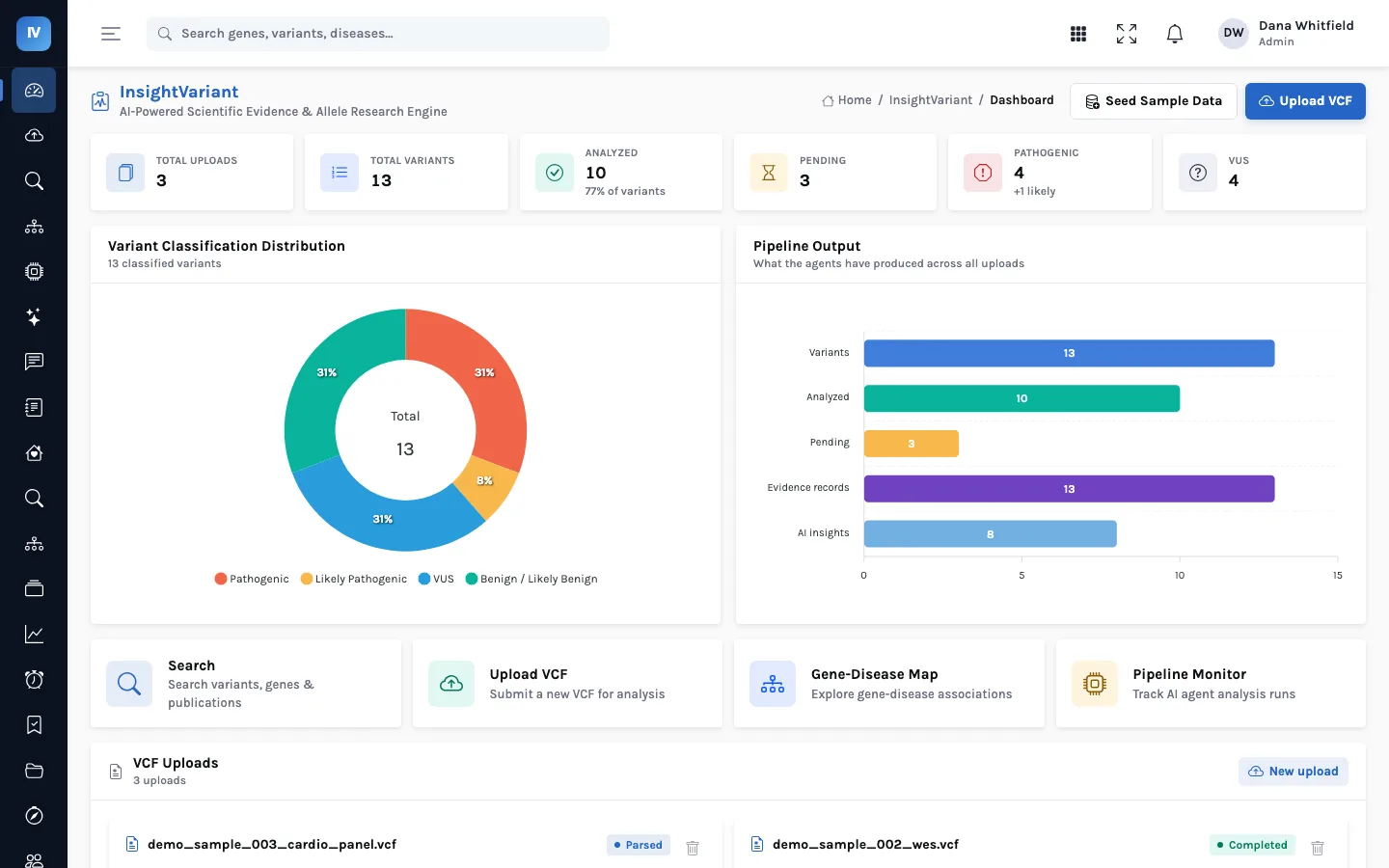
The dashboard counts variants of uncertain significance and pending ones, and the classification donut shows how much of the set is still uncertain. In the upload's variant table, filtering by classification shows the VUS list for that sample.
3. When evidence arrives
When a relevant study appears, a curator prepares it as an evidence record against the variant (study type, population, effect estimate, the excerpt relied on, the ACMG/AMP criteria it bears on, and its strength and direction) and it is loaded with the group's next batch; the app has no form for adding records yet. The insight for the variant cites it. At the group's review the question is concrete: does this record change the criteria met, and is that enough?
- 1Watchcurator
Keep a regular literature check for the genes with open VUS.
- 2Recordcurator
Add each relevant study as an evidence record, with criteria and strength.
- 3Reviewresearch group
Discuss whether the evidence now supports a change, against the framework.
- 4Decideresearch group
Reclassify, or record that it stays uncertain and why.
What tends to move a VUS
In general terms, under the ACMG/AMP framework, the kinds of evidence that most often change an uncertain classification are these. Which codes apply, and at what strength, depends on the gene and any expert panel specification for it.
| Kind of evidence | Can point towards | Typical codes |
|---|---|---|
| Well-validated functional study | Pathogenic or benign | PS3, BS3 |
| Segregation with disease in families | Pathogenic, or benign if it fails to segregate | PP1, BS4 |
| De novo occurrence | Pathogenic | PS2 (parentage confirmed), PM6 (assumed) |
| Population frequency higher than the disorder allows | Benign | BS1, BA1 |
| More observations in affected individuals than controls | Pathogenic | PS4 |
Watching without drowning
The trade-off in VUS follow-up is attention. Re-reviewing every uncertain variant every month uses the group's time on variants where nothing has changed; reviewing only when someone remembers lets them drift. The Halvorsen group reviews a variant when a new evidence record has been loaded for it, and otherwise on a fixed cycle. The evidence count on each Insight Explorer tab, and the evidence count in search results, show at a glance whether anything has been added.
Habits that help
- Record phenotype terms at registration. They are what makes a later literature search targeted, and they are hard to reconstruct afterwards.
- Keep the review date. Annotations record when they were fetched; note when the group last reviewed each VUS so the next review knows what is new.
- Record “no change” too. A review that leaves a variant uncertain is still a decision worth keeping, with the evidence that was considered.
- Separate research from care. Any question about a real person's variant belongs with a qualified clinical laboratory and genetics professional, not a research workspace.
Questions research groups ask
Will InsightVariant tell us when new literature appears?
The Literature agent searches PubMed each time the pipeline runs on a variant, so re-running the analysis on an upload brings in what has been published since. People decide whether it moves the classification.
Can we list every VUS across all our samples?
The dashboard counts them across uploads, each upload's variant table filters by classification, and search finds variants across every upload.
Is a variant that stays uncertain a failed review?
No. Many variants stay uncertain for years because the evidence that would settle them does not yet exist. A review that records what was looked at, and that nothing was enough to move it, is the correct outcome and saves the next reviewer from repeating the search.
What the group gets
An open question that stays open in the system, not in someone's memory. The Literature agent helps with the watching: each re-run brings new studies in as evidence records, and people decide what they mean.
Research use only. InsightVariant does not provide clinical diagnoses or medical advice. The variants shown are well-known public variants (as listed in ClinVar) attached to fictional demo samples; literature records and insight text in the screenshots are fictional placeholders. Variant classification for patient care must be done by qualified professionals under applicable guidelines.