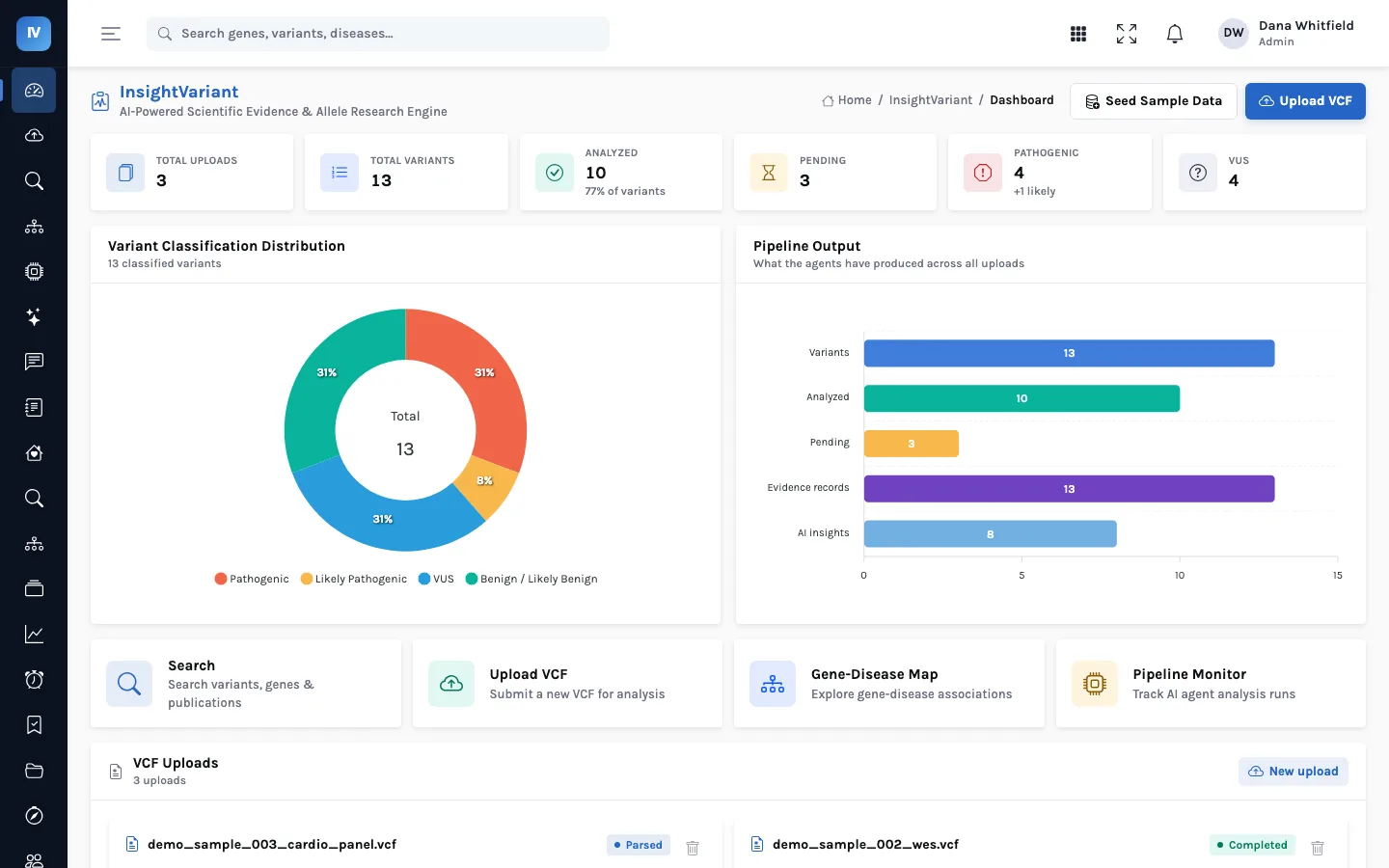
Most genomic variant classifications in research and in public databases use the framework published by the American College of Medical Genetics and Genomics and the Association for Molecular Pathology (ACMG/AMP) in 2015, refined since by expert panels for specific genes. This is a short primer for research teams who need to read such a classification critically.
General information, research use only
This primer simplifies the published framework (Richards et al., Genetics in Medicine, 2015) and does not replace it or the gene-specific specifications from ClinGen expert panels. Classification for patient care is done by qualified professionals in accredited laboratories. Nothing here is medical advice.
In short
- Five tiers: pathogenic, likely pathogenic, uncertain significance, likely benign, benign.
- Evidence comes as codes with a direction (pathogenic or benign) and a strength (very strong to supporting).
- Codes combine by rules into a tier; the codes matter more than the label, because they show the reasoning.
- Ask of every classification: which codes, backed by which evidence, assessed when, and by whom?
The tiers and the codes
A classification is the result of combining evidence codes. On the pathogenic side, PVS1 is very strong evidence (for example a null variant in a gene where loss of function causes disease); PS1–PS4 are strong; PM1–PM6 moderate; PP1–PP5 supporting. On the benign side, BA1 is stand-alone (an allele frequency too high for the disorder); BS1–BS4 are strong and BP1–BP7 supporting. The framework's combining rules turn a set of met codes into a tier: for example, one very strong plus one strong criterion is enough for pathogenic.
The combining rules, simplified
| Tier | Some of the combinations that reach it (2015 rules, simplified) |
|---|---|
| Pathogenic | 1 very strong + at least 1 strong; or 1 very strong + 2 moderate; or 2 or more strong |
| Likely pathogenic | 1 very strong + 1 moderate; or 1 strong + 1 or 2 moderate; or 3 or more moderate |
| Likely benign | 1 strong benign + 1 supporting benign; or 2 or more supporting benign |
| Benign | BA1 alone; or 2 or more strong benign |
| Uncertain significance | The criteria above are not met, or the pathogenic and benign evidence contradict each other |
The published rules have more combinations than this table, including ones that rely on supporting criteria; read them in full before applying them. Later work from ClinGen recasts the same criteria as points on a scale, which makes it easier to see how close a variant is to the next tier.
A worked example, with an invented variant
Take a made-up missense variant in a made-up gene. It is absent from population databases (PM2, whose default weight later guidance has lowered), it sits in a well-studied functional domain (PM1), and computational tools agree it is damaging (PP3). That is two moderate and one supporting criterion: not enough for likely pathogenic under the 2015 rules, so it is a VUS. If a well-validated functional study then shows it disrupts the protein (PS3), one strong plus two moderate criteria reaches likely pathogenic. The label changed because one code was added, and the code is what a reviewer should check.
What the codes draw on
| Kind of evidence | Example codes | Where it lives in InsightVariant |
|---|---|---|
| Population frequency | BA1, BS1, PM2 | gnomAD allele frequency on the variant; gnomAD annotations |
| Computational and predictive | PP3, BP4, PVS1 (variant type) | Consequence and impact on the variant; Ensembl annotations |
| Functional studies | PS3, BS3 | Evidence records of study type functional |
| Segregation and case data | PP1, BS4, PS4 | Evidence records (cohort, case-control) |
| De novo occurrence | PS2, PM6 | Evidence records |
| Other databases and reports | (context, not a code by itself) | ClinVar annotations with review status |
Reading a classification critically
- 1Which codes were applied?
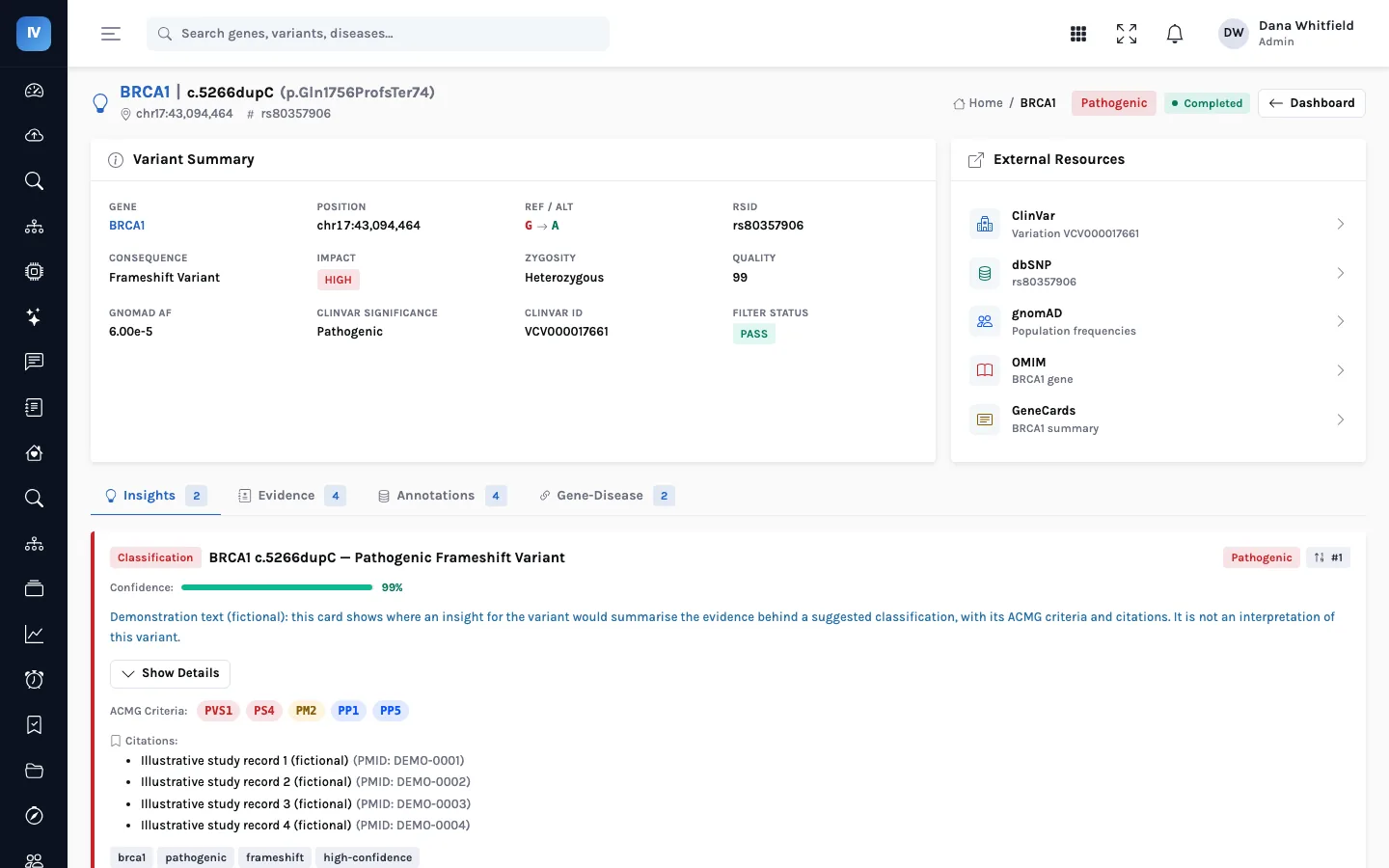
A label without its codes can't be checked. In InsightVariant an insight lists the ACMG/AMP criteria it applied as badges.
- 2Is each code backed by evidence?
Open the evidence tab: each code should have a record of the right kind and strength behind it.
- 3Were strengths adjusted?
Expert panel specifications sometimes raise or lower a code's default strength for a gene. Check which applies.
- 4How current is it?
Classifications change as evidence accumulates. Annotations record when they were fetched; ClinVar shows its review status.
- 5Who assessed it?
A database submission, an expert panel and a single lab carry different weight. ClinVar's review status says which.
Common misreadings
- “Uncertain” as “probably fine”. A VUS means not enough evidence either way. It is an open question.
- One strong paper as proof. Strength codes have defined uses; a single study rarely settles a classification alone.
- Frequency without context. Whether an allele frequency is “too high” depends on the disorder's prevalence, penetrance and inheritance.
- A classification as permanent. Reclassification is normal as evidence grows.
Using the codes in a lab meeting
At the fictional Lindqvist Lab's monthly journal club, each presenter shows one variant's insight with its criteria badges, then the evidence record behind each code. The discussion is about whether each code is justified, not about the final label, which is the habit the framework is meant to build.
Questions research teams ask
Does InsightVariant work out the tier from the codes?
No. A variant's classification and an insight's suggested classification are stored fields, loaded with the records, and the criteria are shown next to them so a reviewer can check the combination. There is no rules engine applying the framework in the current release.
Why do two labs classify the same variant differently?
Usually because they had different evidence, weighed a code at a different strength, or applied a gene-specific specification the other did not. Comparing the codes, not the labels, shows which.
What does ClinVar's review status add?
It says how the public classification was reached: from a single submitter without stated criteria, through multiple submitters in agreement, up to an expert panel or a practice guideline. It is shown on each ClinVar annotation in InsightVariant.
Further reading
Start with the 2015 ACMG/AMP standards and guidelines for the interpretation of sequence variants (Richards et al.), then the ClinGen Sequence Variant Interpretation working group's recommendations and the gene-specific specifications from its expert panels.
Research use only. InsightVariant does not provide clinical diagnoses or medical advice. The variants shown are well-known public variants (as listed in ClinVar) attached to fictional demo samples; literature records and insight text in the screenshots are fictional placeholders. Variant classification for patient care must be done by qualified professionals under applicable guidelines.