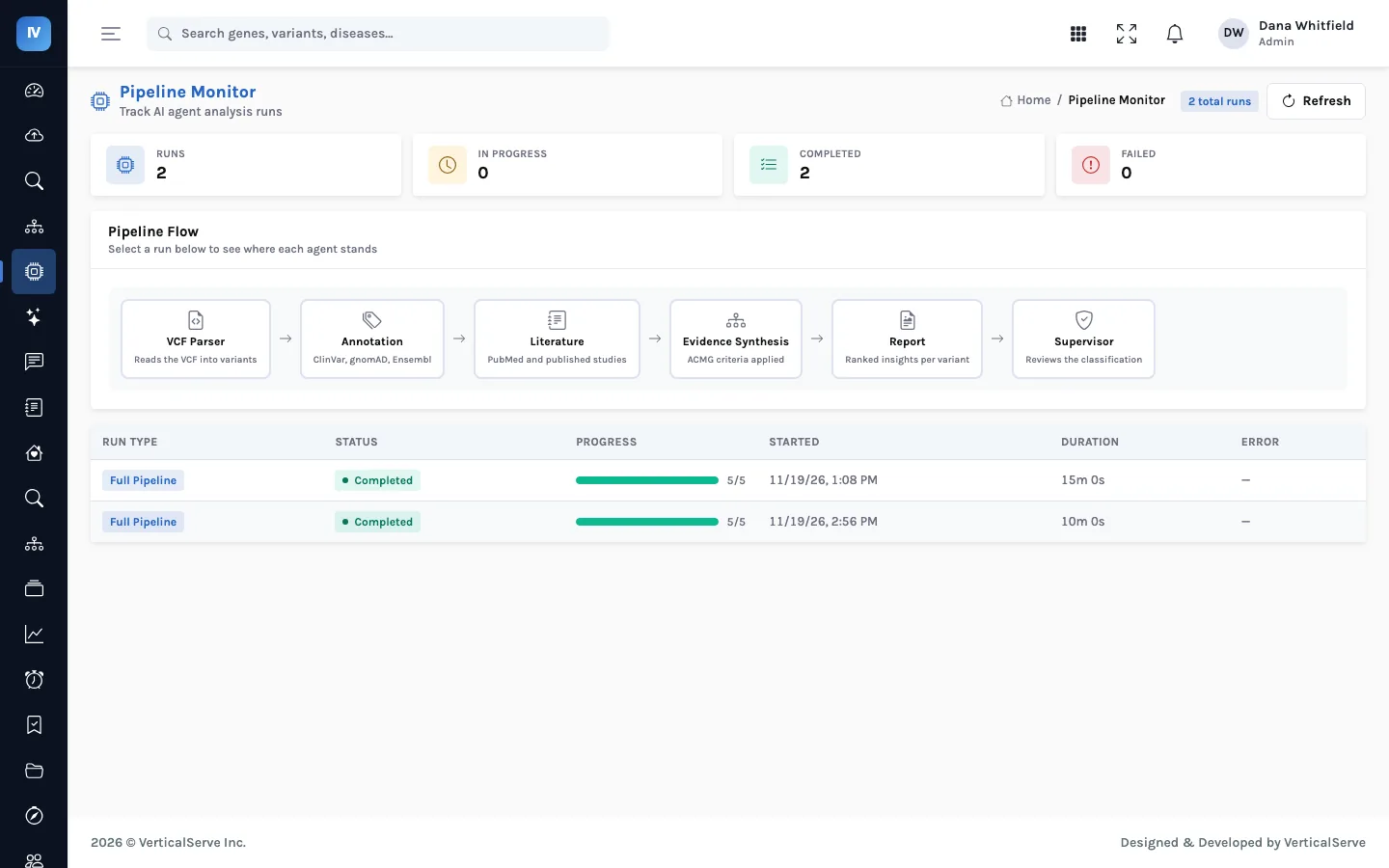
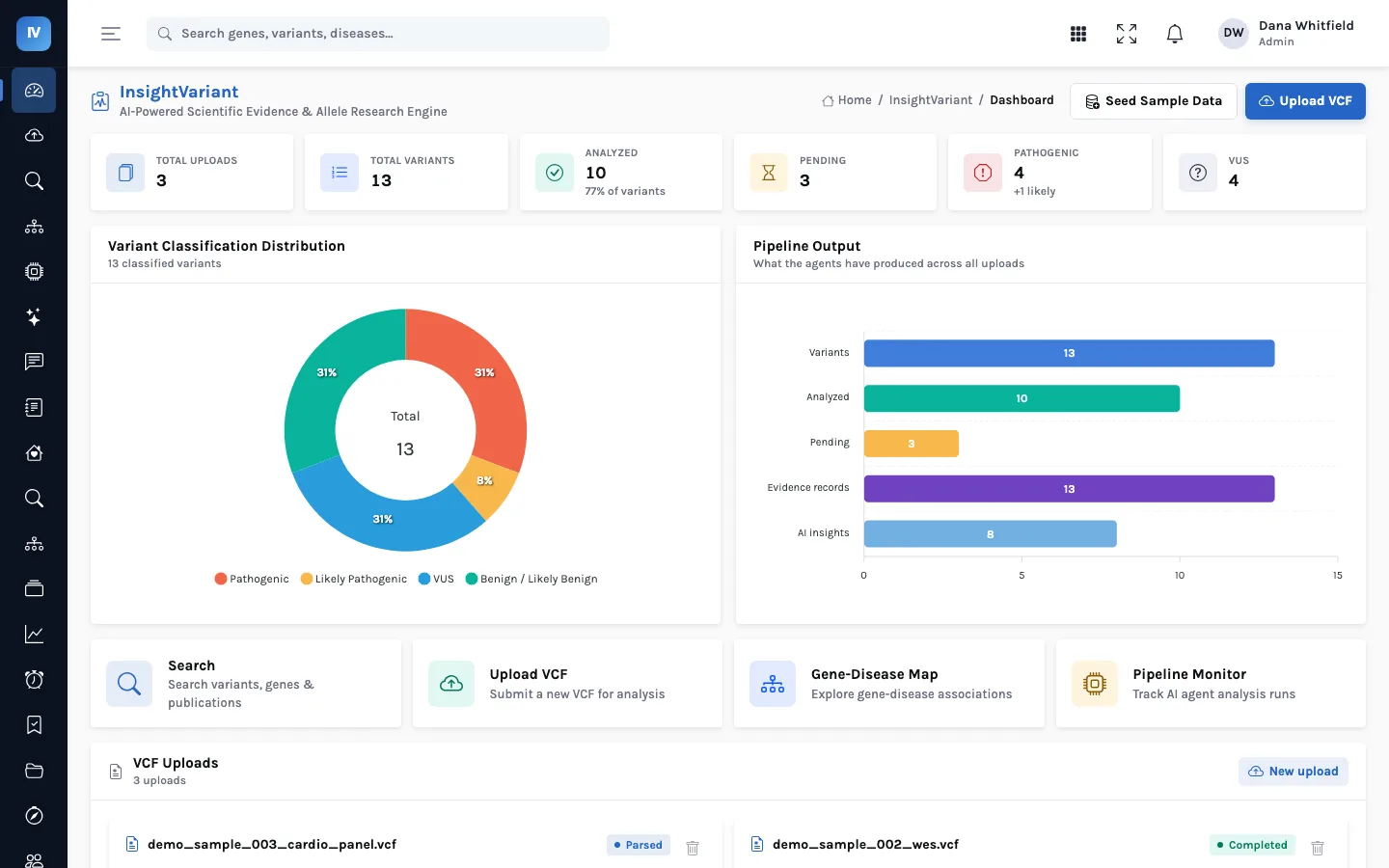
A classification is only as good as the evidence behind it, and the evidence is only useful if someone can check it. InsightVariant stores each piece of literature evidence as a structured record, so a reviewer can see what the study was, what it found, and which criteria it was used for.
In short
- An evidence record keeps the citation, the study design and size, the population, the effect estimate and the excerpt that matters.
- It states which ACMG/AMP criteria it supports, how strongly, and in which direction.
- Insights cite evidence records, so every criterion behind a suggested classification can be traced.
- Structure makes review faster: disagreements are about specific records and criteria, not a paragraph of notes.
The fields
| Field | Why it is there |
|---|---|
| Title, authors, journal, year, PMID, DOI | So the source can be found and read in full |
| Study type | Cohort, case-control, functional, meta-analysis, GWAS or clinical trial: designs carry different weight |
| Cohort size and population | A finding in a small or narrow population may not generalise |
| Effect size, p-value, confidence interval | The strength of the association, as the study reported it |
| Relevant excerpt | The passage relied on, so a reviewer doesn't have to re-read the paper to see the point |
| ACMG/AMP criteria | Which rules of the classification framework the study is evidence for |
| Strength, direction, relevance | How much weight it was given, towards pathogenic or benign, and how relevant it is to this variant |
The evidence detail page
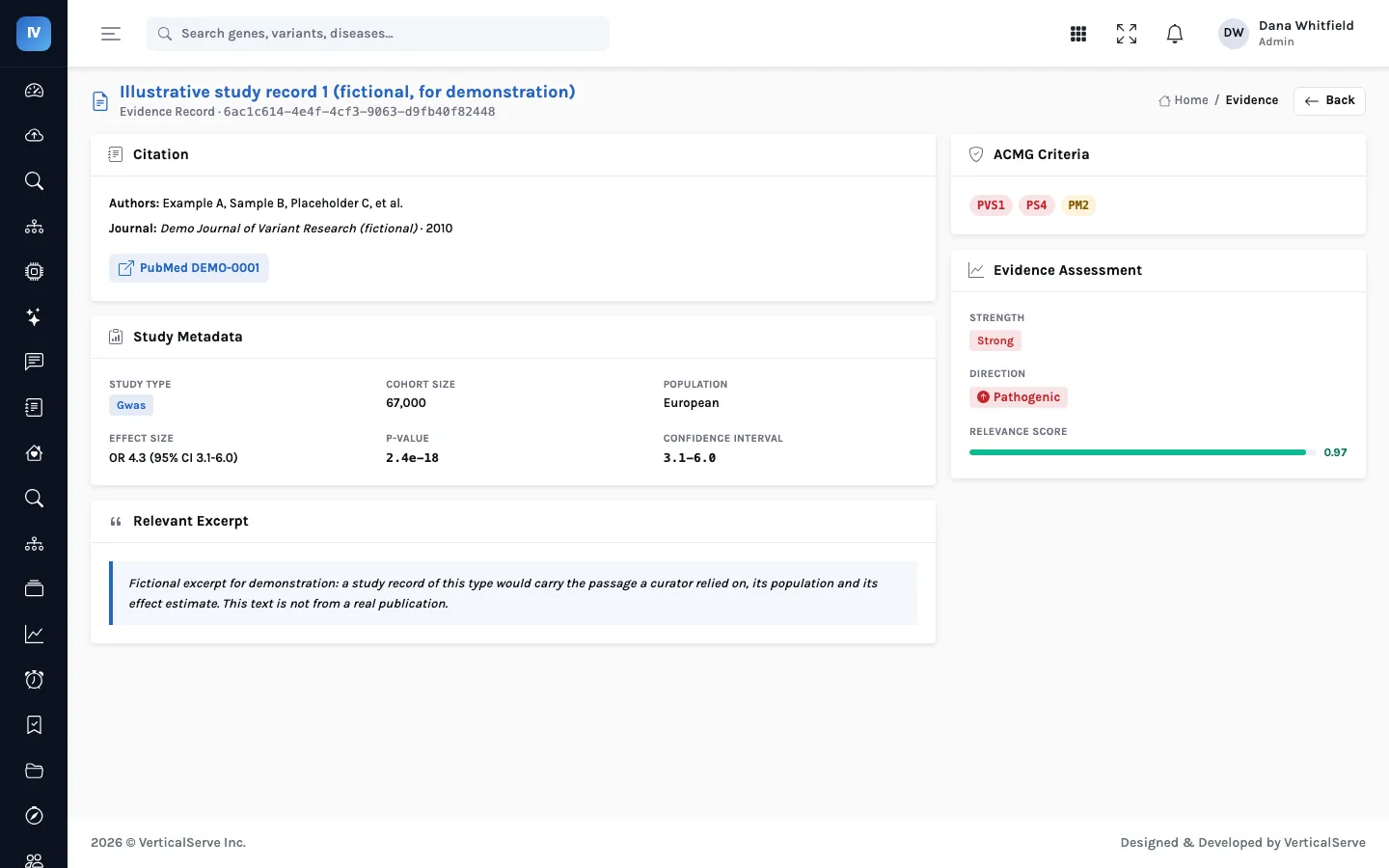
Opening a record shows it in full: the citation with a link to the publication, the study metadata (type, cohort size, population, effect size, p-value, confidence interval), the relevant excerpt, and on the right the ACMG/AMP criteria and the evidence assessment, with strength, direction and a relevance score.
Criteria, strength and direction
The ACMG/AMP framework for sequence variants groups evidence into criteria with a code and a strength: for pathogenicity, very strong (PVS1), strong (PS1–PS4), moderate (PM1–PM6) and supporting (PP1–PP5); for benign, stand-alone (BA1), strong (BS1–BS4) and supporting (BP1–BP7). An evidence record names the codes it supports. Its strength says how much it was weighed (strong, moderate, supporting) and its direction says which way it points (pathogenic, benign or uncertain).
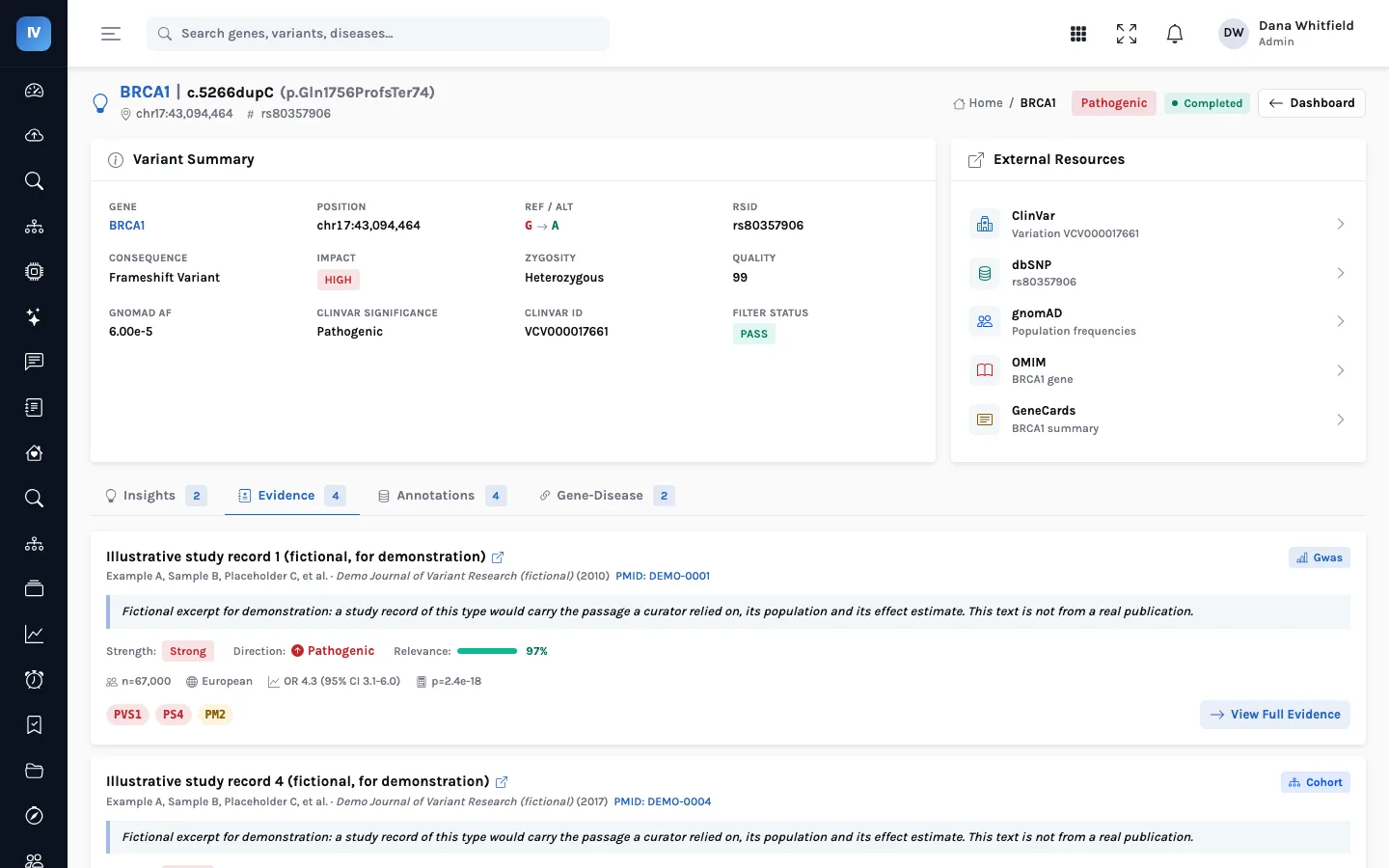
This matters for review. When an insight applies PS4 (prevalence in affected individuals higher than in controls), the reviewer can open the case-control or cohort records it cites and judge whether they justify it. The ACMG/AMP primer explains the framework in more detail.
Recording a functional study properly
Mateo, a curator at the fictional Lindqvist Lab, prepares the record for a functional assay paper on a missense variant, to be loaded with the lab's next batch. Rather than pasting the abstract into a notes column, he records the study type (functional), the assay's result as the effect, the excerpt describing it, and marks it as supporting a functional criterion at moderate strength, pathogenic direction. When the lab revisits the variant a year later, the reasoning is still there, attached to the source.
What makes a good record
- The excerpt is the evidence. Quote the passage the criterion rests on, not the abstract.
- One study, one record. Two experiments in one paper that support different criteria are clearer as two records.
- Direction is not optional. Evidence against pathogenicity is as important to record as evidence for it.
How records get there
The Literature agent in the agent pipeline searches PubMed and proposes records in exactly this structure; records from an existing curation set can be loaded too. Either way, the structure is the same, and a person reviews it.
A record, filled in
Here is what Mateo's record might look like. Every value is invented for illustration; it is not a real study and says nothing about any real variant.
| Field | Example value (fictional) |
|---|---|
| Title, journal, year | A made-up functional assay of missense variants in a made-up gene, Journal of Example Studies, 2024 |
| Study type | functional |
| Cohort size, population | Not applicable (cell-based assay) |
| Effect | Activity reduced compared with the reference allele in the assay |
| Relevant excerpt | The sentence in the results that reports the reduced activity, quoted exactly |
| ACMG/AMP criteria | PS3 applied at moderate strength (the lab's own decision, with its reason) |
| Strength, direction | moderate, pathogenic |
Two things make this record useful later. The excerpt is the sentence relied on, not a summary of the paper. And the decision to use PS3 at less than its default strength is stated on the record, so a reviewer can disagree with it specifically.
From records to an insight
An insight carries the criteria it applied and its citations, and can list the IDs of the evidence records that support it. That link is what makes review possible: from an insight's PS3 badge, the reviewer goes to the evidence tab and finds the functional records. A criterion with no record behind it is the first thing to question.
Questions curators ask
One paper covers three variants. One record or three?
Three. An evidence record belongs to one variant, because its excerpt, criteria and strength are about that variant. The same citation on three records is expected.
Can we find every record from one paper?
Yes. Search covers publications by title, journal, PubMed ID and authors, and the evidence detail page links to PubMed and the DOI.
What about evidence against pathogenicity?
Record it the same way, with direction benign. A record set that only ever points one way is a warning sign about the search, not about the variant.
General information
The ACMG/AMP criteria summary above is a simplification of the published framework (Richards et al., Genetics in Medicine, 2015) and its later specifications by expert panels. Read the original guidance before applying it, and note that classification for patient care is the job of qualified, accredited laboratories.
Research use only. InsightVariant does not provide clinical diagnoses or medical advice. The variants shown are well-known public variants (as listed in ClinVar) attached to fictional demo samples; literature records and insight text in the screenshots are fictional placeholders. Variant classification for patient care must be done by qualified professionals under applicable guidelines.